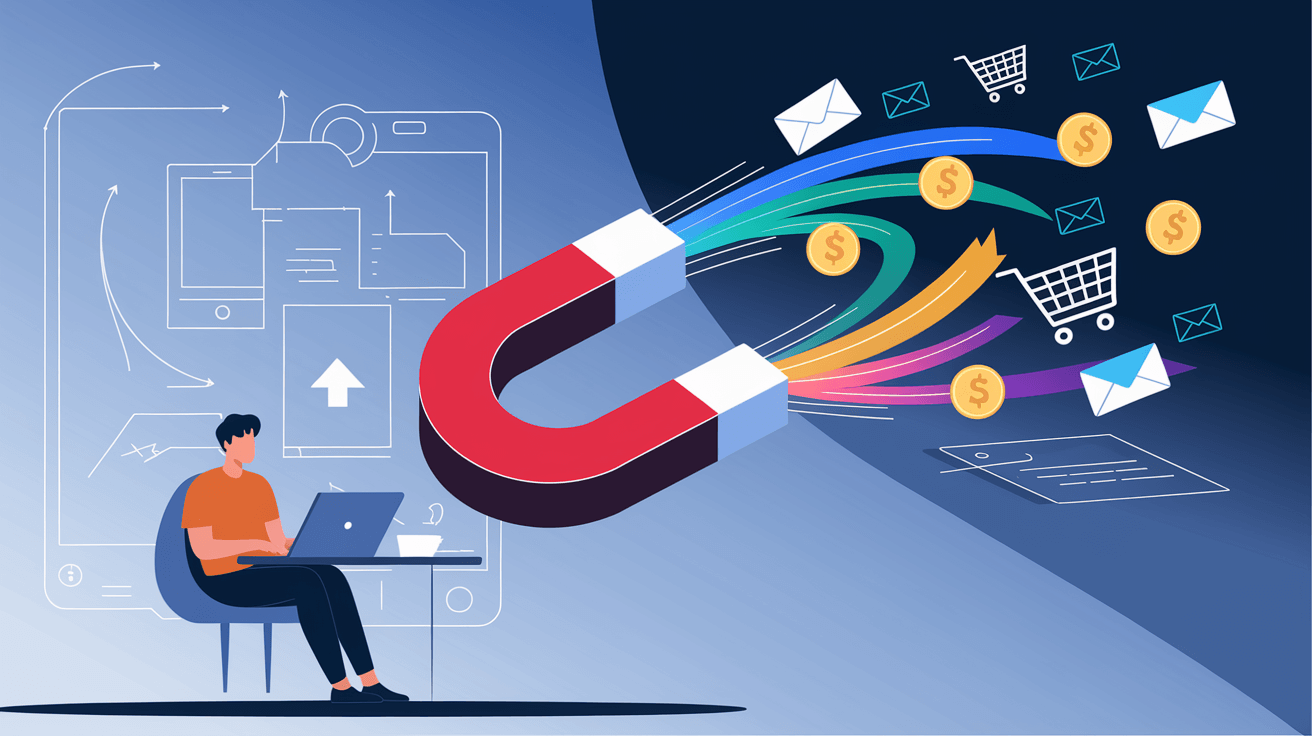
Direct response marketing is a strategy designed to generate an immediate, measurable action from your audience. Instead of simply building brand awareness, its goal is to drive a specific next step: clicking a link, opting into a list, downloading a resource, booking a demo, or making a purchase.
What sets direct response apart is its focus on results. It’s trackable, fast-moving, and intentionally crafted to prompt the customer to do something today, not later.
Core Characteristics of Direct Response Marketing
- Clear offer: A concrete benefit (discount, guide, trial, consultation) with perceived value.
- Specific audience: Tailored messaging for a well-defined segment.
- Singular call to action (CTA): One obvious next step.
- Low friction: Simple, mobile-friendly path to respond.
- Trackability: You can attribute clicks, signups, and revenue to specific campaigns.
- Urgency or scarcity: Ethical deadlines or limited availability to prompt action.
Examples of Direct Response Marketing
- A Facebook or Instagram ad offering a free downloadable guide in exchange for an email address
- An email campaign promoting a 24-hour product discount
- A landing page that drives signups for a webinar or demo
- A YouTube video with a clear CTA to “click the link below”
- Google Search ads with “Get a Quote” or “Start Free Trial” extensions
- SMS messages reminding qualified leads about an expiring offer
- Direct mail postcards with a unique promo code and tracked URL
Each example combines a clear message, a compelling reason to act, and a simple way to respond.
Why Direct Response Works
- It’s measurable: Track CTR, conversion rate, cost per acquisition (CPA), and revenue to optimize with confidence.
- It’s cost-effective: Allocate budget to the creatives, audiences, and channels that convert, and cut what doesn’t.
- It builds relationships: Every response creates a follow-up opportunity via email, retargeting, or SMS.
- It leverages psychology: Clarity, relevance, incentive, and urgency reduce decision friction and drive action.
- It creates a feedback loop: Rapid testing improves offers, messaging, and funnel performance over time.
The Role of Lead Magnets in Direct Response
A lead magnet is a valuable resource offered for free in exchange for contact information. Think of it as the bridge between curiosity and conversion: turning cold audiences into warm, qualified leads.
Why Lead Magnets Work
- They make your offer irresistible: People are more willing to share an email when they get a checklist, quiz, template, toolkit, or training they can use immediately.
- They qualify your audience: The topic signals intent. Someone who downloads “10 Activities to Boost Learning in Toddlers” is a prime lead for an educational toy brand.
- They enable follow-up: Once someone opts in, you can continue the conversation with automated nurture sequences and targeted offers.
High-Converting Lead Magnet Ideas
- Checklists and cheat sheets (fast to consume, high utility)
- Templates and swipe files (plug-and-play value)
- Quizzes and assessments (personalized insights)
- Mini-courses or workshops (perceived high value)
- Calculators and planners (interactive, outcome-focused)
- Free trials or demos (experience the value firsthand)
Tip: Keep delivery instant, value specific, and consumption time short (under 10 minutes is ideal for most offers).
How Direct Response Campaigns Work (From Ad to Revenue)
- Target the right audience: Use interests, intent keywords, lookalikes, or ABM lists.
- Present a compelling offer: Lead magnet, discount, trial, or consult that addresses a real pain or desire.
- Craft persuasive creative: Benefit-led copy and visuals with social proof, urgency, and one clear CTA.
- Send traffic to a focused landing page: Minimal navigation, headline-message match, mobile-first form, and trust elements.
- Capture the response: Short forms, autofill, and alternative response options (chat, click-to-call) where relevant.
- Deliver instantly: Immediate access to the resource, confirmation page, and email.
- Nurture and convert: Follow-up sequence with value, credibility, and timed offers; retarget non-converters.
- Measure and optimize: Track full-funnel metrics and iterate creative, offers, and audiences.
Metrics That Matter
- Reach and frequency: Are you saturating your audience?
- Click-through rate (CTR): Is your ad compelling?
- Landing page conversion rate: Is the page/message aligned with the ad?
- Cost per click (CPC) and cost per lead (CPL): Are you acquiring leads efficiently?
- Cost per acquisition (CPA): What’s the cost to win a customer?
- Return on ad spend (ROAS) and payback period: Are you profitable and how fast?
- Customer lifetime value (LTV): Does your funnel attract high-value customers?
- Attribution: Are you crediting the right touchpoints (last-click vs. multi-touch)?
Best Practices for High-Converting Direct Response
- Lead with outcomes: Show the end result your audience wants, not just features.
- Use proven copy frameworks: AIDA (Attention–Interest–Desire–Action), PAS (Problem–Agitate–Solve), 4U (Useful–Urgent–Unique–Ultra-specific).
- One page, one goal: Keep your landing page focused on a single CTA.
- Reduce friction: Short forms, social login, autofill, and clear privacy assurances.
- Establish trust fast: Testimonials, ratings, logos, case studies, guarantees, and clear FAQs.
- Create ethical urgency: Real deadlines, limited bonuses, or capacity limits (never fake scarcity).
- Design for mobile first: Fast load speed, large tap targets, and minimal distractions.
- Follow up with value: 3–5 email sequence that educates, overcomes objections, and invites the next step.
What to Test (A/B Testing Roadmap)
- Offer: Lead magnet vs. discount vs. trial vs. consult.
- Headline and hook: Outcome-led vs. pain-led vs. contrarian angles.
- Visuals: Product-in-use, lifestyle, UGC, short-form video.
- CTA: Wording, color, placement, sticky vs. inline.
- Form length: Fewer fields vs. progressive profiling.
- Social proof: Case study vs. testimonial vs. data point.
- Page structure: Long-form vs. short-form; above-the-fold emphasis.
- Nurture sequence: Timing, subject lines, and offer ladder.
Test one major variable at a time, run to significance, and use consistent guardrails (CPL, CPA, ROAS) to avoid “winning” tests that hurt revenue.
Common Mistakes (and Fixes)
- Vague offers: Make the benefit concrete and immediate.
- Multiple CTAs: Consolidate to one primary action.
- Message mismatch: Ensure ad copy, creative, and page headline align.
- Too much friction: Remove unnecessary form fields and steps.
- Ignoring post-click: Optimize thank-you pages and nurture flows.
- No tracking discipline: Use UTMs, pixels, and CRM integrations.
- Fake urgency: Damages trust; use real deadlines and caps.
Compliance and Trust
- Obtain explicit consent for email/SMS (GDPR/CCPA/CASL as applicable).
- Provide easy unsubscribe and clear privacy policies.
- Deliver exactly what you promise instantly.
- Be transparent with pricing and terms.
Sample Lead Magnet Landing Page Outline
- Headline: Clear outcome (“Cut Your Acquisition Costs by 30% in 30 Days”)
- Subhead: Brief credibility or mechanism (“Free 7-step checklist used by 1,200+ marketers”)
- Hero visual: Preview of the resource
- Bullets: 3–5 specific takeaways
- Form: Name + email (keep it short), privacy reassurance
- Social proof: Logos, testimonials, or short case stat
- CTA button: Action-oriented (“Get the Checklist”)
- Thank-you page: Instant access + next step (demo, community, related content)
FAQs
How is direct response different from brand marketing?
Brand marketing builds awareness and affinity over time. Direct response drives immediate, trackable actions. The best strategies blend both: brand makes performance cheaper; performance proves brand’s ROI.
How long until I see results?
You can often see early signals within days. Meaningful optimization typically takes 2–4 weeks of testing to reach statistical confidence.
Does direct response work for B2B?
Yes. Use lead magnets (reports, ROI calculators), appointment CTAs, and multi-touch nurture for longer sales cycles.
Is direct mail still effective?
For certain audiences and local markets, yes—especially when paired with QR codes, unique URLs, and follow-up email/SMS.
What budget do I need?
Start with enough to reach significance on a few tests (often a few hundred to a few thousand dollars, depending on CPCs and funnel conversion rates). Scale what works.
Quick-Start Checklist
- Define one target persona and one problem to solve
- Create a specific, high-value lead magnet or offer
- Write outcome-led copy with one CTA
- Build a focused, mobile-first landing page
- Set up UTMs, pixels, and CRM capture
- Launch on 1–2 channels where your audience already is
- Set a 2-week test plan (offer, hook, creative)
- Follow up with a 3–5 email nurture sequence
- Review metrics weekly and iterate ruthlessly